Yesterday marked one year since my Grandmom died. I can cry just writing that sentence, but I won’t since I’m sitting in a coffee shop in Ocean City. Ocean City, where I have so many memories of Grandmom, like her last trip to my parents’ house, where she and I shared the room with the single beds, as we had in so many places over the years. By then, she was an octogenarian widow, and I was a married woman, but for that night, we were two single girls again.
I still miss her so much it physically hurts me. Not all the time. Not all day every day, but it can still hit me with a force that steals my breath, bends me over, clutching the kitchen counter, tears springing forth, bursting out. It’s worse at night. If a wave hits me at night, I can cry and feel like there’s no stopping it—nothing other than exhaustion or dehydration. Sometimes I’ll get into bed, still sniffling, and just hope to fall asleep, which eventually I do.
One of the worst days I’ve had in recent months was the day I changed my hair color. The day after Grandmom died I woke up with a visceral need to change my hair. I walked into a salon in my town and asked them to make me a blond. The change was so dramatic that my husband literally did not recognize me at first. I needed that change, I needed an outward sign that life would never be the same.
As her anniversary approached, I found myself needing to change it again. Needing that year of mourning to be over, an outward sign that the worst had passed. Another change. Another loss.
I didn’t want to be too dark, but I wanted darker. My hairdresser, who prefers brunettes, was only too happy to comply. But when she finished I almost burst into tears. Because Grandmom was really gone. And that time when it was so raw, so present, that’s gone too. Which is good. Life has to go on. But losing the intense grief, somehow that feels like a loss too. Because that was the thing that made me know she was real, she was here, she loved me. And without that, what will I have? Her things. My memories. Ocean City. Her recipes.
Now I am crying in the coffee shop. Embarrassing. But the reason I wanted to write about this is that I don’t think people talk about grief enough. People are ashamed to cry in public, to show sadness. I’m trying to change that about myself. I heard someone say the other day that she grieved her father’s death for decades. That helped me. Because there’s part of me that thinks I should be over it. That Grandmom was 92 years old, lived a full and happy life, died a year ago, that it shouldn’t still hurt.
And it is better. It doesn’t hurt as much or as frequently. But how could you ever stop missing someone you really loved? Someone who made you feel so good with just one look, one squeeze of the hand? Somehow, just being with Grandmom made me know that I was going to be okay, that whatever I was struggling with would work out, and that I would survive it. Her faith in me was so strong that she didn’t even have to say anything, though she often did. I miss laughing with her, I miss confiding in her, having her confide in me. I miss having coffee with her and her friends, feeling so special and cherished. How many people in life actually cherish you? If you’re lucky enough to have one, and you lose them, doesn’t it make sense to feel that loss?
So I just wanted to say, I’m still grieving. I think in some sense, I will always grieve this loss. But I know, I still know, how blessed I am to have a loss like this to grieve. Alice Walker said in a poem that “grief/emotionally speaking/is the same/as gold.” I think I’m beginning to understand what she means.
Saturday, June 5, 2010


Tuesday, May 18, 2010
Why Do I Love the Twilight Saga?
It’s true—I’m a Twi-hard. I’m not stalking Robert Pattinson or anything, but I read all four books of the series, in about a month, and I’ve watched both movies more than once. Now I’m a 33-year-old woman, well-educated and well-read, yet I’m susceptible to a teenage vampire romance. As a writer, it behooves me to try to figure out why.
So for those of you who have yet to succumb to Twilight’s charm, it’s the story of 17-year-old Bella Swan, klutzy and plain, who falls in love with Edward Cullen, 104-year-old vampire in the body of a gorgeous 17-year-old boy. Rob Pattinson comes close to perfection, I admit, but the descriptions of Edward in the book paint a portrait of the most exquisite male specimen humanity has ever seen. And somehow, the amazing supernatural Edward Cullen falls in love with plain old ordinary Bella.
Throughout the first book, which I devoured, I held on to some skepticism about their “love.” It seemed too obsessive, too consuming, too teenager. No one falls in love so completely at 17 and stays that way forever. No one finds their soul mate that young. (Oh, except my parents.) But not nowadays, that doesn’t happen. (Oh, except for my friends James and Stephanie.) Fine, so maybe it happens.
But the talk about completing each other, needing each other, was a bit much for seventeen I thought. I enjoyed the fantasy, escaping into the world of supernatural beings who are so good that they fight their nature, live a moral life in spite of great temptation, and are fabulously wealthy, athletic, beautiful, and funny. Who wouldn’t want to spend time in that world?
But in the second book of the series, New Moon, when Edward breaks up with Bella and leaves, I began to believe that Edward really was her soul mate, that she may live without him, but it was no kind of life. Seeing Bella’s devastation, and feeling it, made me believe in the relationship between the characters. That’s when Stephanie Meyer (the author) got me.
Maybe because I’ve lived through horrible breakups. Maybe because I have a soul mate, and can’t imagine having a complete life without him. Maybe just because Meyer so effectively conveyed the horror of being devastated by love. Bella can live without Edward, she does, but it’s not the same. She will never be the same.
And this all appeals to me why? I like to believe that two people can love each other so completely. Even if it’s hard to believe that can happen when you’re seventeen and last your whole life, sometimes it does. Don’t we all want someone who loves us so much that they would sacrifice their happiness, even their life for us? Bella and Edward’s love is idealized, I’m not sure that humans really love each other like that, but it’s nice to watch and to imagine. Maybe it’s something to strive for—putting your partner’s happiness first, sacrificing for them, protecting them, standing by them, forgiving them when they make a horrible mistake.
Isn’t it nice to think that kind of love is possible?
So for those of you who have yet to succumb to Twilight’s charm, it’s the story of 17-year-old Bella Swan, klutzy and plain, who falls in love with Edward Cullen, 104-year-old vampire in the body of a gorgeous 17-year-old boy. Rob Pattinson comes close to perfection, I admit, but the descriptions of Edward in the book paint a portrait of the most exquisite male specimen humanity has ever seen. And somehow, the amazing supernatural Edward Cullen falls in love with plain old ordinary Bella.
Throughout the first book, which I devoured, I held on to some skepticism about their “love.” It seemed too obsessive, too consuming, too teenager. No one falls in love so completely at 17 and stays that way forever. No one finds their soul mate that young. (Oh, except my parents.) But not nowadays, that doesn’t happen. (Oh, except for my friends James and Stephanie.) Fine, so maybe it happens.
But the talk about completing each other, needing each other, was a bit much for seventeen I thought. I enjoyed the fantasy, escaping into the world of supernatural beings who are so good that they fight their nature, live a moral life in spite of great temptation, and are fabulously wealthy, athletic, beautiful, and funny. Who wouldn’t want to spend time in that world?
But in the second book of the series, New Moon, when Edward breaks up with Bella and leaves, I began to believe that Edward really was her soul mate, that she may live without him, but it was no kind of life. Seeing Bella’s devastation, and feeling it, made me believe in the relationship between the characters. That’s when Stephanie Meyer (the author) got me.
Maybe because I’ve lived through horrible breakups. Maybe because I have a soul mate, and can’t imagine having a complete life without him. Maybe just because Meyer so effectively conveyed the horror of being devastated by love. Bella can live without Edward, she does, but it’s not the same. She will never be the same.
And this all appeals to me why? I like to believe that two people can love each other so completely. Even if it’s hard to believe that can happen when you’re seventeen and last your whole life, sometimes it does. Don’t we all want someone who loves us so much that they would sacrifice their happiness, even their life for us? Bella and Edward’s love is idealized, I’m not sure that humans really love each other like that, but it’s nice to watch and to imagine. Maybe it’s something to strive for—putting your partner’s happiness first, sacrificing for them, protecting them, standing by them, forgiving them when they make a horrible mistake.
Isn’t it nice to think that kind of love is possible?
Friday, May 14, 2010
How Writing Helps Me
Somebody recently asked me to describe what writing meant to me. That question feels a bit unmanageable, but I think I can describe some of the ways in which writing helps me. Here is a non-exhaustive list.
Morning Pages
Every morning for the past few years, when I wake up, before getting out of bed, I write Morning Pages, an exercise from The Artist’s Way. This means filling three pages of a notebook with stream of consciousness writing—in other words, a brain dump, writing without editing, preferably without really thinking—just letting your hand move across the page.
This practice helps me realize what’s lurking in my mind—things I don’t want to think about, things bothering me or nagging at me. It allows me to vent frustrations, give voice to negative feelings and fears, and by not repressing them, I lessen them, become aware of them and sometimes even find steps to take or solutions. Ideas for the novel sometimes surprise me in the Morning Pages, and the practice of writing without editing myself makes writing first drafts of anything much easier.
Fiction
In writing fiction, I can let my imagination roam, I can create. I love to let my fingers fly over the keys see what comes out. Through fiction I explore questions, I watch characters work through difficulties, and in the process, I gain inspiration and ideas I apply to challenges of my own. Plus, it's just great fun.
Nonfiction
Nonfiction is scarier than fiction for me because I have to hew to the facts, like it or not. And if I’m writing about myself, I have to be brave. But this also helps me. I often don’t know what I feel or think about something until I write about it. If I put words on a page, play with them, arrange and rearrange them, at the end of the process, I’ve figured something out, I’ve realized something, and I’ve created something, which is its own satisfaction.
Poems
I don’t write a lot of poems. For me, they are a last resort, when plain old prose cannot capture the moment or emotion I want to describe. Sometimes writing a poem is the only thing that makes me feel better, because even when a situation is awful, there is comfort in creating something beautiful from it.
In all its forms, writing helps me figure out what I feel and what I think. After writing something I’m a little savvier, a little more self-aware. But maybe my favorite way that writing helps me is the satisfaction I feel when someone tells me that my writing has helped them in some way.
Does writing help you?
Morning Pages
Every morning for the past few years, when I wake up, before getting out of bed, I write Morning Pages, an exercise from The Artist’s Way. This means filling three pages of a notebook with stream of consciousness writing—in other words, a brain dump, writing without editing, preferably without really thinking—just letting your hand move across the page.
This practice helps me realize what’s lurking in my mind—things I don’t want to think about, things bothering me or nagging at me. It allows me to vent frustrations, give voice to negative feelings and fears, and by not repressing them, I lessen them, become aware of them and sometimes even find steps to take or solutions. Ideas for the novel sometimes surprise me in the Morning Pages, and the practice of writing without editing myself makes writing first drafts of anything much easier.
Fiction
In writing fiction, I can let my imagination roam, I can create. I love to let my fingers fly over the keys see what comes out. Through fiction I explore questions, I watch characters work through difficulties, and in the process, I gain inspiration and ideas I apply to challenges of my own. Plus, it's just great fun.
Nonfiction
Nonfiction is scarier than fiction for me because I have to hew to the facts, like it or not. And if I’m writing about myself, I have to be brave. But this also helps me. I often don’t know what I feel or think about something until I write about it. If I put words on a page, play with them, arrange and rearrange them, at the end of the process, I’ve figured something out, I’ve realized something, and I’ve created something, which is its own satisfaction.
Poems
I don’t write a lot of poems. For me, they are a last resort, when plain old prose cannot capture the moment or emotion I want to describe. Sometimes writing a poem is the only thing that makes me feel better, because even when a situation is awful, there is comfort in creating something beautiful from it.
In all its forms, writing helps me figure out what I feel and what I think. After writing something I’m a little savvier, a little more self-aware. But maybe my favorite way that writing helps me is the satisfaction I feel when someone tells me that my writing has helped them in some way.
Does writing help you?
Tuesday, April 27, 2010
If You Know How to Worry...
Last week I read this sentiment in a book: If you know how to worry, you know how to meditate.
That blew my mind.
I am a champion worrier. I’m not proud of this, I wish it weren’t true, but it is. I have an obsessive, creative mind, and left to its own devices, it will fixate on all kinds of awful scenarios that will probably never happen. This does not help me.
Recently I’ve been trying, rather than just stopping behavior I don’t like, to replace it with something else. So the sentence about meditating made a lot of sense to me. For the past week or so whenever bad thoughts come into my mind, whenever I start down the path of worry or negativity, I’ve tried to catch myself and think something else instead.
Meditating in this sense is not sitting in the lotus position in a dark room, but focusing your mind on something. I have lots of mantras, sayings, thoughts I’ve collected over the years so I try one of those. It could be “To thine own self be true,” “I am exactly where I am supposed to be,” “Ask and you shall receive,” “God has a plan of goodness for me.” It could be just repeating to myself what I’m doing in that moment---aka “I’m driving the car, I’m driving the car.” The thought that helps will depend on the situation and the person, but I think the concept could help everyone: when you’re worried, switch your thinking to something else. Use that crazy obsessive mind to help yourself!
That blew my mind.
I am a champion worrier. I’m not proud of this, I wish it weren’t true, but it is. I have an obsessive, creative mind, and left to its own devices, it will fixate on all kinds of awful scenarios that will probably never happen. This does not help me.
Recently I’ve been trying, rather than just stopping behavior I don’t like, to replace it with something else. So the sentence about meditating made a lot of sense to me. For the past week or so whenever bad thoughts come into my mind, whenever I start down the path of worry or negativity, I’ve tried to catch myself and think something else instead.
Meditating in this sense is not sitting in the lotus position in a dark room, but focusing your mind on something. I have lots of mantras, sayings, thoughts I’ve collected over the years so I try one of those. It could be “To thine own self be true,” “I am exactly where I am supposed to be,” “Ask and you shall receive,” “God has a plan of goodness for me.” It could be just repeating to myself what I’m doing in that moment---aka “I’m driving the car, I’m driving the car.” The thought that helps will depend on the situation and the person, but I think the concept could help everyone: when you’re worried, switch your thinking to something else. Use that crazy obsessive mind to help yourself!
Monday, February 22, 2010
Olympia

Watching the Winter Olympics, starring cold and ice, made me long for Olympia, Greece, the stop on my cruise that followed Crete. After docking at the lovely port town of Katakolon, and driving through the scenic Kalamata countryside (covered with olive trees, just as you would imagine) we arrived at Olympia, birthplace of the Olympics.
Even before I learned that Olympia was a sacred site to the ancient Greeks, I felt the holiness in the air—something about the mountain mist, the quiet, the light. The Olympics were part of a festival that honored Zeus, and included processions, ceremonies, sacrifices and prayers as well as athletic contests. Games were held at Olympia as early as 776 B.C. and continued for more than 1,000 years. For each Olympiad a sacred truce was enacted to allow the athletes, spectators and pilgrims to travel safely to the site. The contests included footraces, discus and javelin, wrestling, boxing and equestrian events.
On our tour we saw the gymnasium, where athletes trained in the nude. “Think about that the next time you’re at the gym,” said our guide, Demetrios. Then we admired the Philippeion, (pictured above) a building Alexander the Great had built in honor of his father, and according to Demetrios, one of the most beautiful buildings in ancient Greece.
Most impressive to me was the imposing Temple of Zeus which once housed the gigantic gold and ivory statue of Zeus that was one of the Seven Wonders of the Ancient World. Though unfortunately the statue has disappeared without a trace, the size of the one pillar that remains standing (34 feet tall, 7 feet thick, weighing 9 tons!) allows you to imagine the grandeur of the original structure, worthy of the King of the Gods.

Temple of Zeus.

Temple of Zeus
After passing Hera’s altar, where the Olympic torch is lit for each modern Olympics, we paraded through the gateway to the stadium, where athletes competed as early as 2,500 years ago. The marble start and finish lines are still there, begging tourists to pose on them. Demetrios reluctantly allowed us to take photos, but only if we stood at the starting line, as the ancient Greeks would have.

Me behaving like a tourist.
As I watched the Olympics over the last two weeks, I thought of Olympia and the ideas from ancient Greece that live on: that sports can bring people together, can bring peace, at least temporarily; and that competition, which causes us to strive for greatness, pleases the gods.
Wednesday, February 17, 2010
Valentine's Day in Harlem
I don’t really celebrate Valentine’s Day. Maybe too many Februarys without a sweetheart scarred me; maybe I find overpriced red roses and prix fixe meals at crowded restaurants annoying. However, as a person in a ten-year relationship, I do appreciate an excuse for romance. So on February 13, Carl and I did some sweet things—saw a movie, relived memories from our early relationship, held hands. But on the 14th, we eschewed all things traditional and headed off to Harlem.
We met Carl’s brother Kenneth, who was visiting from California, at 125th Street and took the A train uptown to The Cloisters, a medieval art museum at the northern tip of Manhattan. From the subway stop we climbed up the winding paths of Fort Tryon park, the icy breeze invigorating as our hearts pounded, not in romantic thrill, but the effort of climbing up to the museum, though the quiet snow-covered park, the views of the Hudson, and arriving at a medieval monastery did have a certain charm.
Once inside my husband asked at the coat check if the museum had anything special happening for Valentine’s Day. The clerk looked even more surprised by this question than I must have, finally saying, “You being here, that’s what’s special.” As if that wasn’t sweet enough, fifteen minutes later, he tracked me down to tell me he had thought of some romantic items on view in the Treasury, including a wooden box depicting the German goddess of love spearing someone with an arrow. Standing in front of that box later, I squeezed Carl’s hand and kissed his cheek, seized by Valentine’s spirit.
We left Medieval Europe and traveled back to Harlem, searching out the outpost of Dinosaur Bar-B-Que, a Syracuse institution, where the brisket and ribs are worth the hour wait, especially when you can watch The Orange on TV. The red bows in the bartenders’ hair, little bottles of champagne on many tables and Valentinis splashing out of glasses were festive without being obnoxious, and the crowd of mostly large family parties was perfect for our own party of three.
Leaving Dinosaur, heavier and slower, though happier, we walked from 131st and 12th Ave, peeked into Grant’s Tomb, continued on to Columbia where some enterprising students had built an actual igloo on the quad. (We peeked into that too.) Onward we marched to the Cathedral of St. John the Divine, the largest gothic-style cathedral in the world, longer than two football fields and tall enough to accommodate the Statue of Liberty (without her pedestal).
The size of the building is what impressed me most, though I also loved the rosette stained-glass window and the American Poet’s Corner, which included Edna St. Vincent Millay and this quotation of hers: “Take up the song; forget the epitaph.” Maybe not romantic, but inspiring to this poet.
From there we walked through Morningside Park, up 125th Street, the commercial artery of Harlem, past The Apollo, and all the street vendors with their hearts, teddy bears, and flowers, ending up where we had started.
Exploring New York, visiting museums, cathedrals, parks, wandering down streets known and unknown, feasting on barbeque, sharing it with two people I love—that’s pretty close to my ideal day. What more could I ask for in Valentine’s Day?
We met Carl’s brother Kenneth, who was visiting from California, at 125th Street and took the A train uptown to The Cloisters, a medieval art museum at the northern tip of Manhattan. From the subway stop we climbed up the winding paths of Fort Tryon park, the icy breeze invigorating as our hearts pounded, not in romantic thrill, but the effort of climbing up to the museum, though the quiet snow-covered park, the views of the Hudson, and arriving at a medieval monastery did have a certain charm.
Once inside my husband asked at the coat check if the museum had anything special happening for Valentine’s Day. The clerk looked even more surprised by this question than I must have, finally saying, “You being here, that’s what’s special.” As if that wasn’t sweet enough, fifteen minutes later, he tracked me down to tell me he had thought of some romantic items on view in the Treasury, including a wooden box depicting the German goddess of love spearing someone with an arrow. Standing in front of that box later, I squeezed Carl’s hand and kissed his cheek, seized by Valentine’s spirit.
We left Medieval Europe and traveled back to Harlem, searching out the outpost of Dinosaur Bar-B-Que, a Syracuse institution, where the brisket and ribs are worth the hour wait, especially when you can watch The Orange on TV. The red bows in the bartenders’ hair, little bottles of champagne on many tables and Valentinis splashing out of glasses were festive without being obnoxious, and the crowd of mostly large family parties was perfect for our own party of three.
Leaving Dinosaur, heavier and slower, though happier, we walked from 131st and 12th Ave, peeked into Grant’s Tomb, continued on to Columbia where some enterprising students had built an actual igloo on the quad. (We peeked into that too.) Onward we marched to the Cathedral of St. John the Divine, the largest gothic-style cathedral in the world, longer than two football fields and tall enough to accommodate the Statue of Liberty (without her pedestal).
The size of the building is what impressed me most, though I also loved the rosette stained-glass window and the American Poet’s Corner, which included Edna St. Vincent Millay and this quotation of hers: “Take up the song; forget the epitaph.” Maybe not romantic, but inspiring to this poet.
From there we walked through Morningside Park, up 125th Street, the commercial artery of Harlem, past The Apollo, and all the street vendors with their hearts, teddy bears, and flowers, ending up where we had started.
Exploring New York, visiting museums, cathedrals, parks, wandering down streets known and unknown, feasting on barbeque, sharing it with two people I love—that’s pretty close to my ideal day. What more could I ask for in Valentine’s Day?
Wednesday, January 13, 2010
Labyrinth, Minotaur, Crete oh my!
I wanted to go on this cruise as soon as my aunt and uncle mentioned it to me. Greece, Malta, Tunisia, Spain, Portugal, I thought "Yes, yes, yes, yes and yes." It wasn't until I got the itinerary that I learned we were going to Crete, and when I saw that we could tour King Minos' palace, I had to look twice. King Minos, as in the guy who built the labyrinth to house the Minotaur? Wasn't that just a myth?
For those of you who don't remember, King Minos was the guy who thought he could trick Poseidon, the sea god, by sacrificing not the bull Poseidon had sent him, which was exceptionally beautiful, but a substitute bull.
Apparently King Minos hadn't heard any other myths, because the gods always find out when you try to trick them, and they have very creative forms of revenge. In this case, Poseidon made Minos' wife fall in love with the bull, resulting in her bearing its child, a half-man, half-bull--the Minotaur.
Minos had his architect Daedalus construct a labyrinth to house the Minotaur. Wackiness ensued, including children regularly sacrificed to the Minotaur, until Theseus showed up from Athens to kill it. When Minos locked Daedalus and his son in the labyrinth as a punishment for helping Theseus, the clever architect designed wings from wax and feathers so they could escape. What child can forget the story of Icarus, who disobeyed his father, flew too close to the sun, which melted the wax on his wings and sent him plummeting to his death?
The stories swirled through my brain as we drove to Knossos, the archaeological site. The ruins themselves were, especially after the Parthenon, not very impressive--no labyrinth. But walking around the site of Europe's oldest civilization, with settlements dating from 7,000 B.C., I felt inspired as a storyteller, because long after the palaces came crashing down, the stories remained.
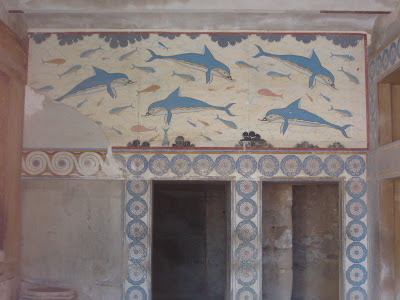

Above are recreated frescoes on the palace walls at Knossos.
Below, according to my tour guide, is the oldest road in Europe.

Sailing away from Crete. Pretty, huh?

For those of you who don't remember, King Minos was the guy who thought he could trick Poseidon, the sea god, by sacrificing not the bull Poseidon had sent him, which was exceptionally beautiful, but a substitute bull.
Apparently King Minos hadn't heard any other myths, because the gods always find out when you try to trick them, and they have very creative forms of revenge. In this case, Poseidon made Minos' wife fall in love with the bull, resulting in her bearing its child, a half-man, half-bull--the Minotaur.
Minos had his architect Daedalus construct a labyrinth to house the Minotaur. Wackiness ensued, including children regularly sacrificed to the Minotaur, until Theseus showed up from Athens to kill it. When Minos locked Daedalus and his son in the labyrinth as a punishment for helping Theseus, the clever architect designed wings from wax and feathers so they could escape. What child can forget the story of Icarus, who disobeyed his father, flew too close to the sun, which melted the wax on his wings and sent him plummeting to his death?
The stories swirled through my brain as we drove to Knossos, the archaeological site. The ruins themselves were, especially after the Parthenon, not very impressive--no labyrinth. But walking around the site of Europe's oldest civilization, with settlements dating from 7,000 B.C., I felt inspired as a storyteller, because long after the palaces came crashing down, the stories remained.


Above are recreated frescoes on the palace walls at Knossos.
Below, according to my tour guide, is the oldest road in Europe.

Sailing away from Crete. Pretty, huh?

Subscribe to:
Posts (Atom)


 Posts
Posts

